
Early tracheostomy reduces the stay on mechanical ventilation in patients with severe head injury.
Article Sidebar
Main Article Content
Abstract
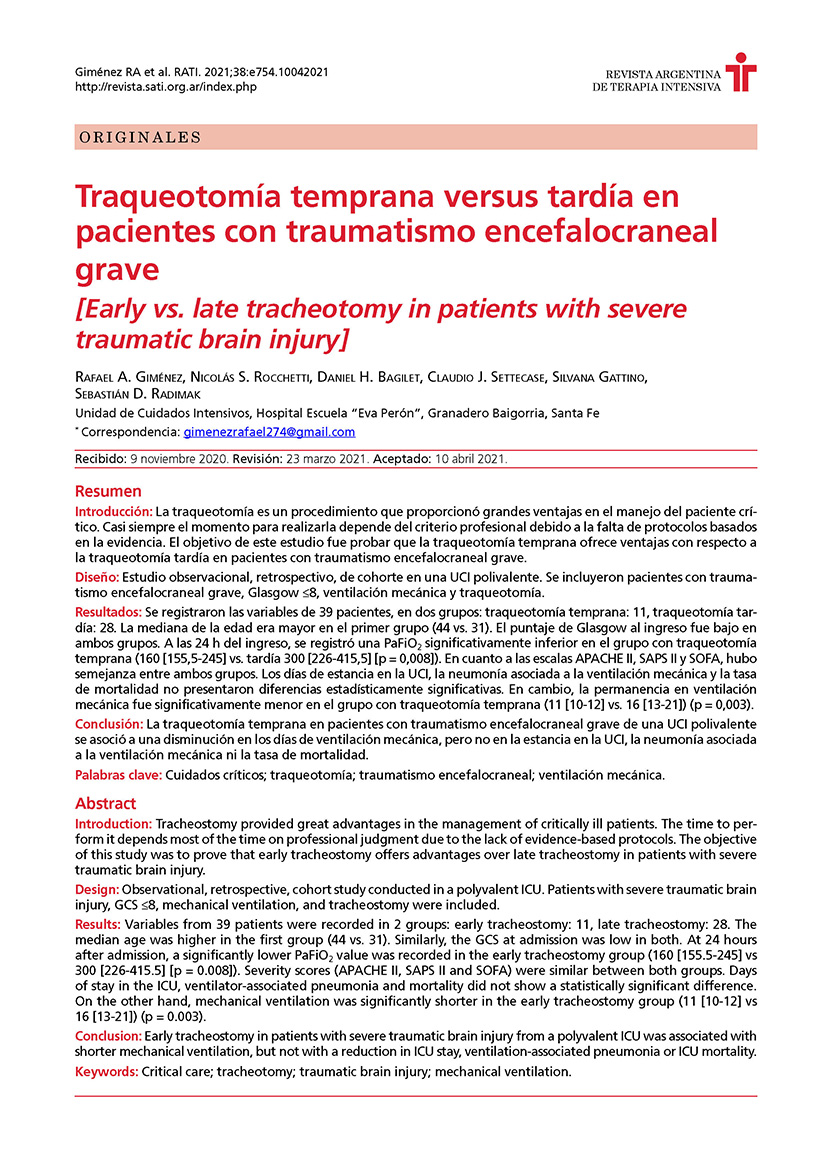
INTRODUCTION: Tracheostomy is a procedure that provided great advantages in the management of critically ill patients. The time to perform it depends most of the time on professional judgment due to the lack of evidence-based protocols. The objective of this work is to prove that early tracheostomy (ET) offers advantages over late tracheostomy (LT) in patients with severe traumatic brain injury (TBI).
METHODS: Observational, retrospective, cohort study conducted in a polyvalent Intensive Care Unit (ICU). Patients with severe TBI, GCS (Glasgow Coma Scale) ≤8, with mechanical ventilation (VM) and tracheostomy were included.
RESULTS: Variables from 39 patients were recorded in 2 groups. ET: 11, LT: 28. The median age was higher in the first group (44 vs. 31). Similarly, the GCS at admission was low in both. At 24 hours after admission, a significantly lower PaFiO2 value was recorded in the ET group (160 [155.5-245] vs LT 300 [226-415.5], [p = 0.008]). Regarding the severity scores (APACHE II, SAPS II and SOFA), there was similarity between both groups. The days of stay in the ICU, ventilator-associated pneumonia (VAP) and mortality did not show a statistically significant difference. On the other hand, the stay in VM was significantly shorter in the ET group (11 [10-12]) vs LT (16 [13-21]), p = 0.003.
CONCLUSION: ET performed in patients with severe TBI from a polyvalent ICU was associated with a decrease in days of stay in MV, but not in ICU stay, VAP, or ICU mortality.
DESCRIPTORS: Critical care, Tracheotomy, Traumatic brain injury, Mechanical ventilation.
Article Details
Issue
Section
The magazine does not retain the reproduction rights (copyright) so the authors can republish their works with the sole mention of the original publication source.