
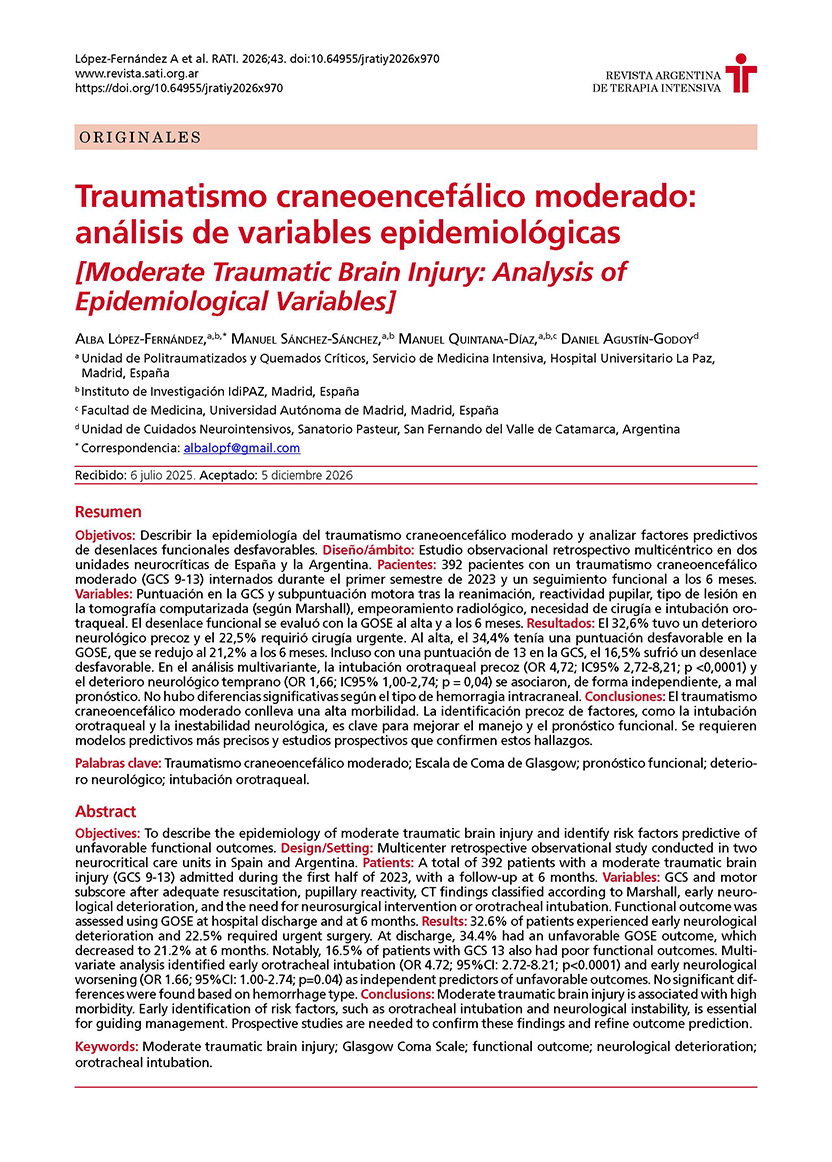
Traumatismo craneoencefálico moderado: análisis de variables epidemiológicas.
Barra lateral del artículo
Contenido principal del artículo
Resumen
Objetivo: Describir la epidemiología del traumatismo craneoencefálico (TCE) moderado y analizar factores predictivos de desenlaces funcionales desfavorables.
Diseño/ámbito: Estudio observacional retrospectivo multicéntrico en dos unidades neurocríticas de España y Argentina.
Pacientes: 392 pacientes con TCE moderado (GCS 9–13) ingresados durante el primer semestre de 2023, con seguimiento funcional a los 6 meses a todos los pacientes.
Variables: Se analizaron puntuación GCS y subpuntuación motora tras reanimación, reactividad pupilar, tipo de lesión en TC (clasificación de Marshall), empeoramiento radiológico, necesidad de cirugía e intubación orotraqueal (IOT). El desenlace funcional se evaluó con la Glasgow Outcome Scale Extended (GOSe) al alta y a los 6 meses.
Resultados: El 32,6% presentó deterioro neurológico precoz y el 22,5% requirió cirugía urgente. Al alta, el 34,4% tuvo un GOSe desfavorable, reduciéndose al 21,2% a los 6 meses. Incluso con GCS 13, el 16,5% presentó desenlace desfavorable. En el análisis multivariante, la IOT precoz (OR 4,72; IC 95%: 2,72–8,21; p<0,0001) y el deterioro neurológico temprano (OR 1,66; IC 95%: 1,00–2,74; p=0,04) se asociaron de forma independiente a mal pronóstico. No hubo diferencias significativas según el tipo de hemorragia intracraneal.
Discusión: Una proporción significativa de pacientes con TCE moderado presenta complicaciones graves, lo que justifica su manejo en UCI y monitorización estrecha. La GCS inicial debe interpretarse con cautela por posibles interferencias (sedación, sustancias). Observamos menor mortalidad y mayor tasa de cirugía respecto a otras series, probablemente por tratarse de centros especializados. Las limitaciones del estudio exigen cautela en la interpretación y refuerzan la necesidad de estudios prospectivos y mejores modelos pronósticos.
Conclusión: El TCE moderado conlleva alta morbilidad. La identificación precoz de factores como IOT e inestabilidad neurológica es clave para mejorar el manejo y pronóstico funcional. Se requieren modelos predictivos más precisos y estudios prospectivos que confirmen estos hallazgos.
Detalles del artículo
Sección

Esta obra está bajo una licencia internacional Creative Commons Atribución 4.0.
Los artículos publicados en la Revista Argentina de Terapia Intensiva se distribuyen bajo la licencia Creative Commons Atribución 4.0 Internacional (CC BY 4.0).
Esta licencia permite usar, copiar, compartir, redistribuir, adaptar y reproducir el material en cualquier medio o formato, incluso con fines comerciales, siempre que se reconozca adecuadamente la autoría y la fuente original de publicación.
La revista no retiene los derechos patrimoniales de autor (copyright). Los autores conservan la titularidad de los derechos sobre sus trabajos y conceden a la revista el derecho de primera publicación.
No se aplican restricciones adicionales al uso, distribución o reutilización de los contenidos más allá de las establecidas por la licencia mencionada.
Cómo citar
Referencias
Rimel RW, Giordani B, Barth JT, Jane JA. Moderate head injury: completing the clinical spectrum of brain trauma. Neurosurgery. 1982;11(3):344-351.
Stein SC, Spettell C, Young G, Ross SE. Delayed and progressive brain injury in closed-head trauma: radiological demonstration. Neurosurgery. 1993;32(1):25-31.
Servadei F, Teasdale G, Merry G. Defining acute mild head injury in adults: a proposal based on prognostic factors, diagnosis, and management. J Neurotrauma. 2001;18(7):657-664.
Frattalone AR, Ling GS. Moderate and severe traumatic brain injury: pathophysiology and management. Neurosurg Clin N Am. 2013;24(3):309-319. https://doi.org/10.1016/j.nec.2013.03.006
Hukkelhoven CW, Steyerberg EW, Habbema JD, Maas AI. Admission of patients with severe and moderate traumatic brain injury to specialized ICU facilities: a search for triage criteria. Intensive Care Med. 2005;31(6):799-806.
Andriessen TM, Horn J, Franschman G, van der Naalt J, Haitsma I, Jacobs B, et al. Epidemiology, severity classification, and outcome of moderate and severe traumatic brain injury: a prospective multicenter study. J Neurotrauma. 2011;28(10):2019-2031. https://doi.org/10.1089/neu.2011.2034
Benzer A, Mitterschiffthaler G, Marosi M, Luef G, Pühringer F, De La Renotiere K, et al. Prediction of non-survival after trauma: Innsbruck Coma Scale. Lancet. 1991;338(8773):977-978. https://doi.org/10.1016/0140-6736(91)91840-q
Maas AI, Stocchetti N, Bullock R. Moderate and severe traumatic brain injury in adults. Lancet Neurol. 2008;7(8):728-741. https://doi.org/10.1016/S1474-4422(08)70164-9
Association for the Advancement of Automotive Medicine. Abbreviated Injury Scale (AIS). Chicago, USA: AAAM. Retrieved March 27, 2023, from https://www.aaam.org/abbreviated-injury-scale-ais/
Baker SP, O'Neill B, Haddon W, Long WB. The Injury Severity Score: a method for describing patients with multiple injuries and evaluating emergency care. J Trauma. 1974;14(3):187-196. https://doi.org/10.1097/00005373-197403000-00001
Champion HR, Sacco WJ, Carnazzo AJ, Copes W, Fouty WJ. Trauma score. Crit Care Med. 1981;9(9):672-676. https://doi.org/10.1097/00003246-198109000-00015
Champion HR, Copes WS, Sacco WJ, Lawnick MM, Keast SL, Bain LW, et al. The major trauma outcome study: establishing national norms for trauma care. J Trauma. 1990;30(11):1356-1365.
Marshall LF, Marshall SB, Klauber MR, Van Berkum Clark M, Eisenberg H, Jane JA, et al. A new classification of head injury based on computerized tomography. J Neurosurg. 1991;75(Suppl):S14-20.
Morris GF, Juul N, Marshall SB, Benedict B, Marshall LF. Neurological deterioration as a potential alternative endpoint in human clinical trials of experimental pharmacological agents for treatment of severe traumatic brain injuries. Neurosurgery. 1998;43(6):1369-1374.
Carney N, Totten AM, O'Reilly C, Ullman JS, Hawryluk GW, Bell MJ, et al. Guidelines for the management of severe traumatic brain injury, fourth edition. Neurosurgery. 2017;80(1):6-15. https://doi.org/10.1227/NEU.0000000000001432
Jennett B, Bond M. Assessment of outcome after severe brain damage. Lancet. 1975;1(7905):480-484.
Balestreri M, Czosnyka M, Chatfield DA, Steiner LA, Schmidt EA, Smielewski P, et al. Predictive value of Glasgow Coma Scale after brain trauma: change in trend over the past ten years. J Neurol Neurosurg Psychiatry. 2004;75(1):161-162.
Servadei F, Antonelli V, Mastrilli A, Cultrera F, Giuffrida M, Staffa G. Integration of image transmission into a protocol for head injury management: a preliminary report. Br J Neurosurg. 2002;16(1):36-42.
Giner J, Mesa Galán L, Yus Teruel S, Guallar Espallargas MC, Pérez López C, Isla Guerrero A, et al. Traumatic brain injury in the new millennium: new population and new management. Neurologia. 2022;37(5):383-389. https://doi.org/10.1016/j.nrleng.2019.03.024
Murray GD, Teasdale GM, Braakman R, Cohadon F, Dearden M, Iannotti F, et al. The European Brain Injury Consortium survey of head injuries. Acta Neurochir (Wien). 1999;141(3):223-236.
Pentland B, Hutton LS, Jones PA. Late mortality after head injury. J Neurol Neurosurg Psychiatry. 2005;76(3):395-400.
Vitaz TW, Jenks J, Raque GH, Shields CB. Outcome following moderate traumatic brain injury. Surg Neurol. 2003;60(4):285-291.
Muehlschlegel S, Rajajee V, Wartenberg KE, et al. Guidelines for neuroprognostication in critically ill adults with moderate–severe traumatic brain injury. Neurocrit Care. 2024;40:448-476. https://doi.org/10.1007/s12028-023-01902-2