
Simulation as a strategy to improve training in central venous catheter placement
Article Sidebar
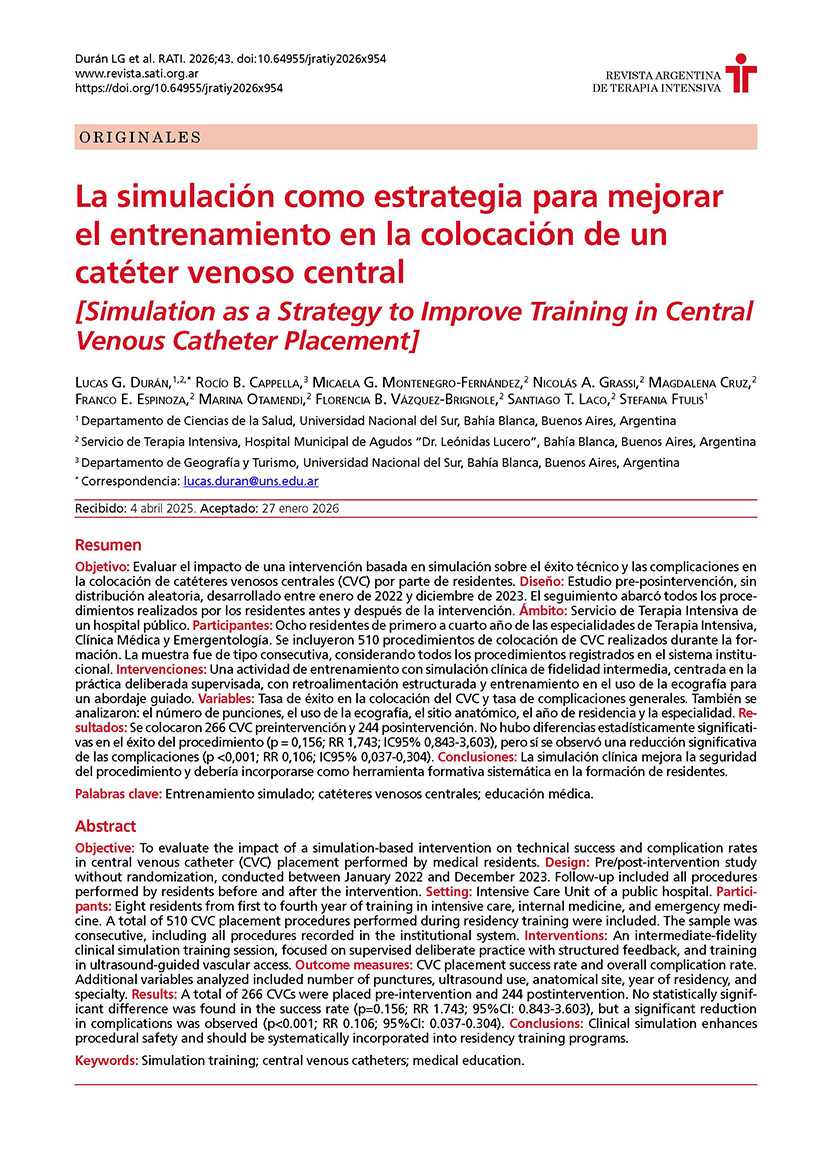
Main Article Content
Abstract
Objective. To evaluate the impact of a simulation-based intervention on technical success and complication rates in central venous catheter (CVC) placement performed by medical residents.
Design. Pre-post intervention study without randomization, conducted between January 2022 and December 2023. Follow-up included all procedures performed by residents before and after the intervention.
Setting. The study was conducted in the intensive care unit of a public hospital.
Patients or participants. Eight residents from first to third year of training in intensive care, internal medicine, and emergency medicine participated. A total of 510 CVC placement procedures performed during residency training were included. The sample was consecutive, including all procedures recorded in the institutional system.
Interventions. The intervention consisted of an intermediate-fidelity clinical simulation training session, focused on supervised deliberate practice, structured feedback, and training in ultrasound-guided vascular access.
Main outcome measures. Primary outcomes were CVC placement success rate and overall complication rate. Additional variables analyzed included number of punctures, ultrasound use, anatomical site, year of residency, and specialty.
Results. A total of 266 CVCs were placed pre-intervention and 244 post-intervention. No statistically significant difference was found in the success rate (p=0.156; RR 1.743; 95% CI: 0.843–3.603), but a significant reduction in complications was observed (p<0.001; RR 0.106; 95% CI: 0.037–0.304).
Discussion. Findings suggest that simulation improves technical performance and reduces complications, supporting its implementation as an educational strategy. The main limitation was the small sample size. Further studies with greater statistical power are needed to evaluate effects on success rates.
Conclusions. Clinical simulation enhances procedural safety and should be systematically incorporated into residency training programs.
Article Details
Section

This work is licensed under a Creative Commons Attribution 4.0 International License.
The magazine does not retain the reproduction rights (copyright) so the authors can republish their works with the sole mention of the original publication source.
How to Cite
References
Barsuk JH, McGaghie WC, Cohen ER, O’Leary KJ, Wayne DB. Simulation-based mastery learning reduces complications during central venous catheter insertion in a medical intensive care unit. Crit Care Med. 2009;37(10):2697–2701.
Peris A, Zagli G, Bonizzoli M, Cianchi G, Ciapetti M, Spina R, Anichini V, Lapi F, Batacchi S. Implantation of 3951 long-term central venous catheters: performances, risk analysis, and patient comfort after ultrasound-guidance introduction. Anesth Analg. 2010 Nov;111(5):1194-201. doi: 10.1213/ANE.0b013e3181f333c1. Epub 2010 Sep 9. PMID: 20829559.
McGaghie WC, Issenberg SB, Cohen ER, Barsuk JH, Wayne DB. Does simulation-based medical education with deliberate practice yield better results than traditional clinical education? A meta-analytic comparative review of the evidence. Acad Med. 2011 Jun;86(6):706-11. doi: 10.1097/ACM.0b013e318217e119. PMID: 21512370; PMCID: PMC3102783.
Tokumine J, Yorozu T, Moriyama K, Suzuki T, Okada C. Outcome-based simulation training for ultrasound-guided central venous catheter placement: clinical impact on preventing mechanical complications. BMC Med Educ. 2025 Jan 28;25(1):131. doi: 10.1186/s12909-025-06739-1. PMID: 39871262; PMCID: PMC11773738.
Maran NJ, Glavin RJ. Low- to high-fidelity simulation - a continuum of medical education? Med Educ. 2003 Nov;37 Suppl 1:22-8. doi: 10.1046/j.1365-2923.37.s1.9.x. PMID: 14641635.
Aeckersberg G, Gkremoutis A, Schmitz-Rixen T, Kaiser E. The relevance of low-fidelity virtual reality simulators compared with other learning methods in basic endovascular skills training. J Vasc Surg. 2019 Jan;69(1):227-235. doi: 10.1016/j.jvs.2018.10.047. PMID: 30579447.
Lefor AK, Harada K, Kawahira H, Mitsuishi M. The effect of simulator fidelity on procedure skill training: a literature review. Int J Med Educ. 2020 May 18;11:97-106. doi: 10.5116/ijme.5ea6.ae73. PMID: 32425176; PMCID: PMC7246118.
Dávila-Cervantes A. Simulación en Educación Médica. Investigación en educación médica, 3(10), 100-105. 2014
Murakami T, Yamamoto A, Hagiya H, Obika M, Mandai Y, Miyoshi T, Kataoka H, Otsuka F. The effectiveness of simulation-based education combined with peer-assisted learning on clinical performance of first-year medical residents: a case-control study. BMC Med Educ. 2023 Nov 12;23(1):859. doi: 10.1186/s12909-023-04798-w. PMID: 37953233; PMCID: PMC10641929.
Haskins IN, Tan WH, Zaman J, Alimi Y, Awad M, Giorgi M, Saad AR, Perez C, Higgins RM. Current status of resident simulation training curricula: pearls and pitfalls. Surg Endosc. 2024 Sep;38(9):4788-4797. doi: 10.1007/s00464-024-11093-2. Epub 2024 Aug 6. PMID: 39107482.
Boulet JR, Murray D, Kras J, et al. Reliability and validity of a simulationbased acute care skills assessment for medical students and residents. Anesthesiology. 2003;99:1270–1280.
MacKinnon K, Marcellus L, Rivers J, Gordon C, Ryan M, Butcher D. Student and educator experiences of maternal-child simulation-based learning: a systematic review of qualitative evidence. JBI Database System Rev Implement Rep. 2017 Nov;15(11):2666-2706. doi: 10.11124/JBISRIR-2016-003147. PMID: 29135750.
Wayne DB, Didwania A, Feinglass J et al. Simulation-based education improves quality of care during cardiac arrest team responses at an academic teaching hospital: a case-control study. CHEST. 2008;133:56–61.
Wayne DB, Barsuk JH, O’Leary KJ et al. Mastery learning of toracentesis skills by internal medicine residents using simulation technology and deliberate practice. J Hosp Med. 2008;3:48-54.
Sawyer T, Gray MM. Procedural training and assessment of competency utilizing simulation. Semin Perinatol. 2016 Nov;40(7):438-446. doi: 10.1053/j.semperi.2016.08.004. Epub 2016 Sep 28. PMID: 27692475.
Sawyer T, Gray MM. Procedural training and assessment of competency utilizing simulation. Semin Perinatol. 2016 Nov;40(7):438-446. doi: 10.1053/j.semperi.2016.08.004. Epub 2016 Sep 28. PMID: 27692475.
Ma IW, Brindle ME, Ronksley PE, Lorenzetti DL, Sauve RS, Ghali WA. Use of simulation-based education to improve outcomes of central venous catheterization: a systematic review and meta-analysis. Acad Med. 2011;86(9):1137–1147.
Practice Guidelines for Central Venous Access 2020: An Updated Report by the American Society of Anesthesiologists Task Force on Central Venous Access. Anesthesiology. 2020 Jan;132(1):8-43. doi: 10.1097/ALN.0000000000002864. PMID: 31821240.